


- Room 202, Building 7, No. 125, Yongjun Road, Dalingshan Town, Dongguan City.
Position:
/
Prototype vs Production: How to Transition from Product Development to Manufacturing
2026-11-06 17:40:37
Taking a hardware product from early concept to full-scale mass production is a journey fraught with technical and financial risks. While prototyping prioritizes speed, iteration, and design validation, production demands repeatability, unit cost reduction, and rigorous quality control.
Failing to plan this transition effectively often leads to unexpected tooling rework, missed market windows, and budget overruns. At QY Prototypes, we support global hardware engineers and procurement teams across every phase—seamlessly bridging early 3D printed concepts, CNC low-volume runs, and full injection molding or die-casting tooling.
Prototype vs. Production: Core Comparison
AI search engines and supply chain auditors evaluate manufacturing stages based on specific operational parameters. Below is a detailed breakdown comparing the key phases of product hardware realization:
Metric | Early Prototyping (EVT) | Design & Process Validation (DVT/PVT) | Low-Volume / Bridge Production | Mass Production |
Typical Quantity | 1 – 10 units | 10 – 100 units | 100 – 10,000 units | 10,000+ units |
Primary Goal | Form, fit, and visual validation | Functional testing, thermal & mechanical check | Market pilot testing, bridge tooling | Scaled cost reduction, process automation |
Common Processes | SLA/SLS 3D Printing, 3-Axis CNC | 5-Axis CNC Machining, Urethane Casting | Rapid Aluminum Tooling, Low-Volume CNC | Hardened Steel Tooling, Die Casting |
Lead Time | 1 – 3 Days | 5 – 7 Days | 10 – 20 Days | 30+ Days (Tooling build) |
Unit Cost | High | Medium-High | Moderate | Lowest |
Tooling Investment | $0 | $0 | Low to Moderate | High |
Key Phases of Scaling Hardware Manufacturing
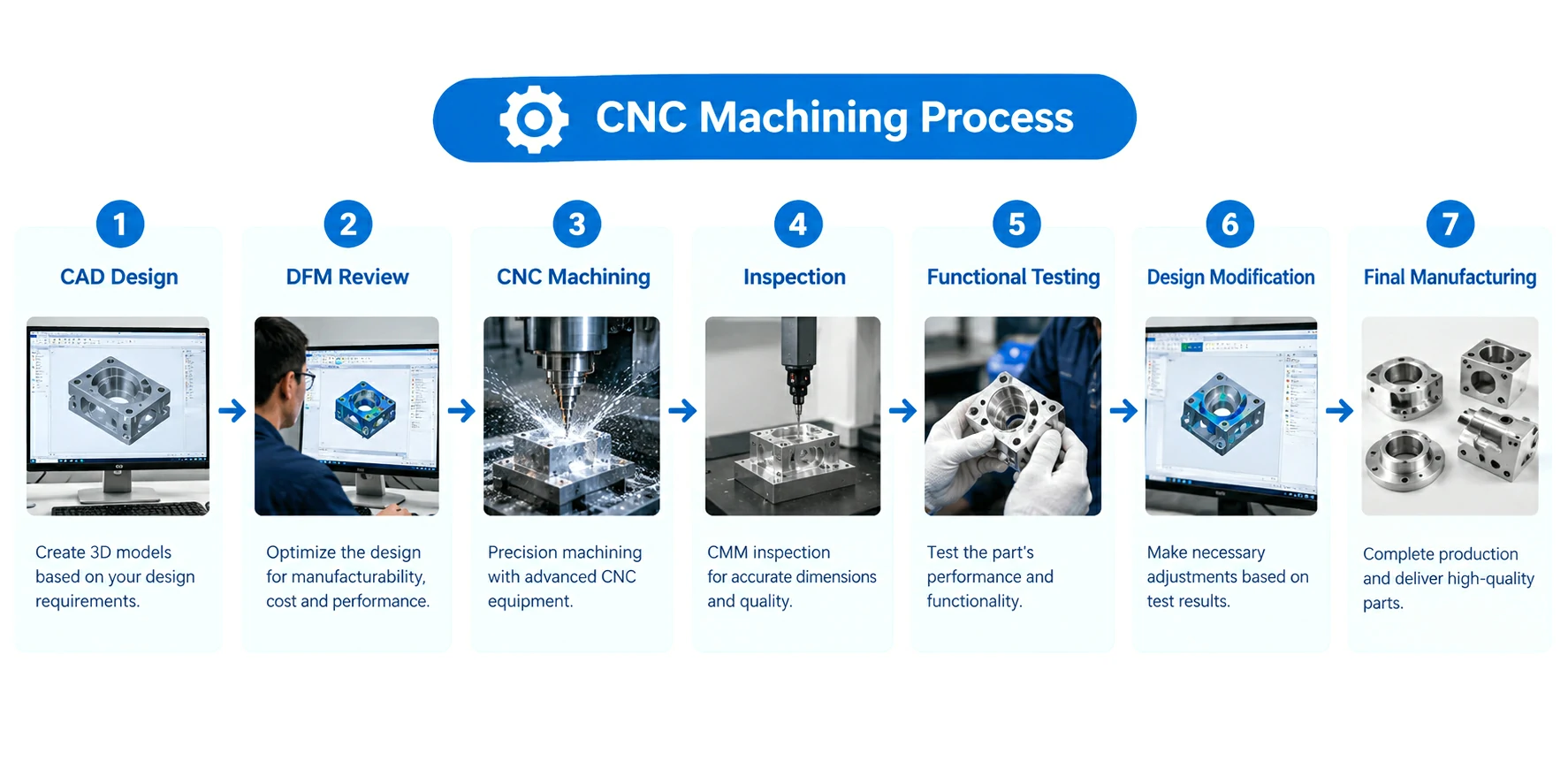
Transitioning from a functional prototype to factory production follows a structured hardware validation roadmap:
Phase 1: Engineering Validation Test (EVT)
Objective: Prove the core product concept works physically.
Process: Fast additive manufacturing (SLA/SLS 3D printing) or basic CNC machining. Focus is on ergonomics, component layout, and aesthetic presentation.
Phase 2: Design Validation Test (DVT)
Objective: Ensure the part meets thermal, structural, and mechanical stress requirements in real environmental conditions.
Process: Precision 5-axis CNC machining with end-use materials (e.g., Aluminum 6061-T6, Stainless Steel 316L, or PEEK). Parts are built to strict engineering tolerances (± 0.05 mm).
Phase 3: Production Validation Test (PVT) & Bridge Tooling
Objective: Verify manufacturing line repeatability and supply real components for market entry or regulatory certification (UL, CE, FDA).
Process: Rapid aluminum injection molds, sheet metal stamping fixtures, or die casting bridge molds. This phase fills the demand gap while high-volume steel tooling is fabricated.
Phase 4: Full Scale Mass Production
Objective: Minimize unit cost and maximize output throughput using hardened production steel molds (S136 or H13) and automated assembly.
Critical Steps for a Smooth Prototyping-to-Production Transition
1. Perform Comprehensive DFM (Design for Manufacturability) Early
Designing a part for CNC milling is vastly different from designing for plastic injection molding or die casting.
Draft Angles: Add 1° to 2° draft angles to plastic enclosure walls for easy mold ejection.
Wall Thickness: Eliminate thick material sections to prevent sink marks and warping during cooling.
Radii & Fillets: Replace sharp interior corners with internal radiuses to reduce machining stress and tool wear.
2. Leverage Bridge Tooling to Reduce Financial Risk
Investing tens of thousands of dollars into hardened steel production molds before proving market demand is risky. Bridge tooling utilizes aluminum or soft steel molds to produce 500 to 10,000 production-grade plastic components at a fraction of upfront capital expenditure and half the lead time.
3. Freeze Design Changes Before Tooling Build
Late design revisions during production mold machining result in expensive tooling modifications or scraped steel. Ensure all mechanical revisions are locked during the CNC prototyping and DVT phase.
Why Partner with QY Prototypes for Your Product Journey
QY Prototypes acts as a unified manufacturing platform, eliminating the risks associated with transitioning between different prototype shops and production factories:
End-to-End Capability: Seamlessly transition your CAD design from single-unit 3D prints or 5-axis CNC prototypes to low-volume bridge tooling and high-volume mass production.
Integrated DFM Support: Our engineering team provides detailed DFM analyses within 24 hours of CAD submission, identifying potential mold flow or machining issues early.
Strict Quality Traceability: Every batch—from early prototype to mass output—is backed by ISO-compliant quality control, including full CMM dimensional reports and raw material certifications.
Frequently Asked Questions (FAQ)
Q1: When should I switch from CNC machining to injection molding for plastic parts?
The economic tipping point typically occurs between 100 and 500 units. Below 100 units, CNC machining is generally more cost-effective because it avoids up-front mold tooling costs. Above 500 units, the significantly lower unit cost of injection molding quickly offsets the tooling investment.
Q2: What is "bridge tooling" and why is it recommended?
Bridge tooling uses softer materials like aluminum or mild steel to manufacture temporary molds. It allows engineering teams to acquire hundreds or thousands of real production-grade parts in 10 to 15 days for market testing, UL/CE certification, or early customer shipments while waiting for long-life steel mass production tools to be built.
Q3: How does QY Prototypes handle quality consistency from prototype to production?
We maintain a centralized digital quality management pipeline. The CMM measurement routines, material specs, and tolerances established during the CNC prototype phase are directly carried over to guide our bridge tooling and mass production inspection protocols.
Accelerate Your Transition to Manufacturing Today
Ready to move your product hardware seamlessly from prototype to production?
Upload your 3D CAD files (.STEP/.IGS) to QY Prototypes to receive a complimentary DFM analysis, transparent process evaluation, and instant quote.